
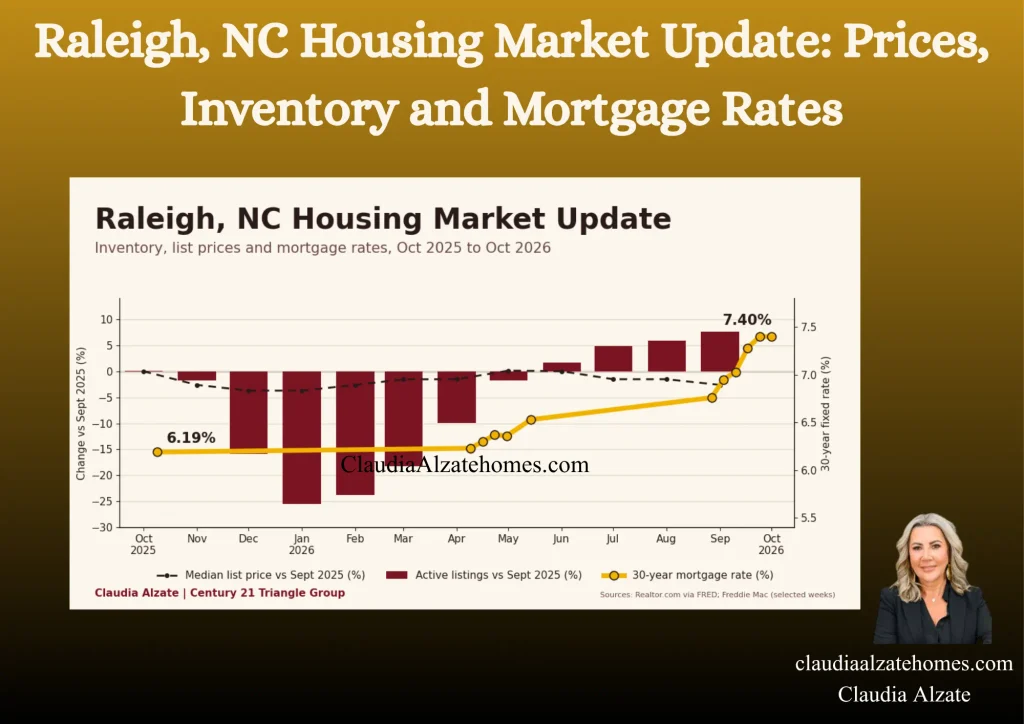
The Raleigh real estate market has long been defined by fast-moving listings and strong buyer competition. This fall, however, a notable shift is emerging: prices are easing and buyers have more homes to choose from, yet the monthly cost of owning a home is higher than it was a year ago. This trend is reshaping how buyers shop and how sellers price, and it comes down to mortgage rates, rising taxes and insurance, and a market where negotiation is back on the table. Here is what is really happening in Raleigh, NC market right now, and what it means for your next move.
Where the Raleigh Market Stands Right Now
Let’s start with the most complete local snapshot.
| Measure | September 2026 | September 2025 | Change |
| Median sale price | $425,000 | $445,000 | Down 4.5% |
| Closed sales | 472 | 525 | Down 10.1% |
| Homes for sale | 2,180 | 2,065 | Up 5.6% |
| Months of supply | 4.1 | 3.8 | Up from 3.8 |
| Days on market | 37 | 36 | Up 1 day |
| Original list price received | 95.6% | 95.6% | Unchanged |
What do these numbers mean in plain terms? Fewer homes closed, and the ones on the market are taking slightly longer to sell. Inventory grew even though fewer new homes were listed, which tells us homes are being absorbed more slowly. The median price dropped 4.5%, but the average sale price stayed flat at about $570,000, so part of that drop reflects which homes happened to sell this month, not every home losing 4.5% of its value.
What Is Changing in the Market
More Choices and More Room to Negotiate
With 4.1 months of supply, Raleigh is moving toward the middle of the range generally considered balanced. For buyers, that means you can tour several comparable homes instead of rushing into the first one. For sellers, a first-weekend offer is no longer something to count on.
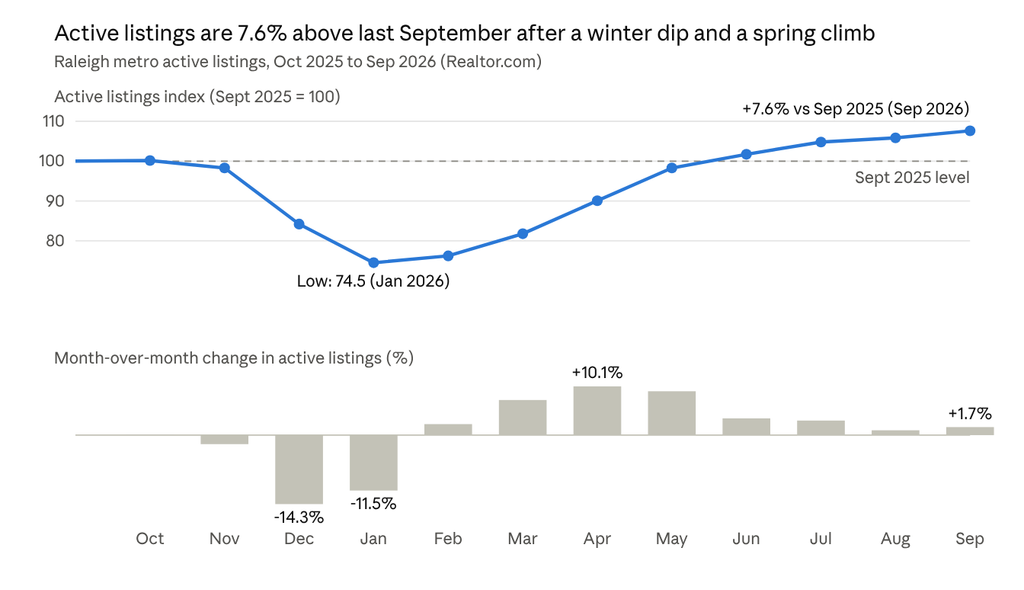
Active listings fell by about a quarter over the winter, then grew every month from February. They are now 7.6% above last September.
Prices Are Easing, and the Sources Agree
Homes priced above what recent sales support are sitting longer and needing price changes, and the numbers back that up. The median sale price is $425,000, down 4.5% from last September, and other trackers point the same way: about $414,800 over the past three months, down 4.6%, about $440,000 in September, down roughly 6.8% (Realtor.com), and a typical home value of $428,671 in August, down about 1.7%. Each source measures a little differently, so the dollar amounts vary, but the direction is the same.
Time on market is stretching too. Homes are taking a median of 44 days to sell, up from 38 a year ago, and September’s median reached 58 days. Zillow’s index reflects the typical value of a home whether or not it sold, so it moves more gently than sale prices, and it shows homes going pending in about 28 days. For context, that typical value is $474,337 in Wake County, $334,773 across North Carolina and $368,697 nationally. Within Raleigh, ZIP code 27615 sits near $540,000 (up 0.2%), while ZIP code 27616 is closer to $351,000 (down 3.4%).
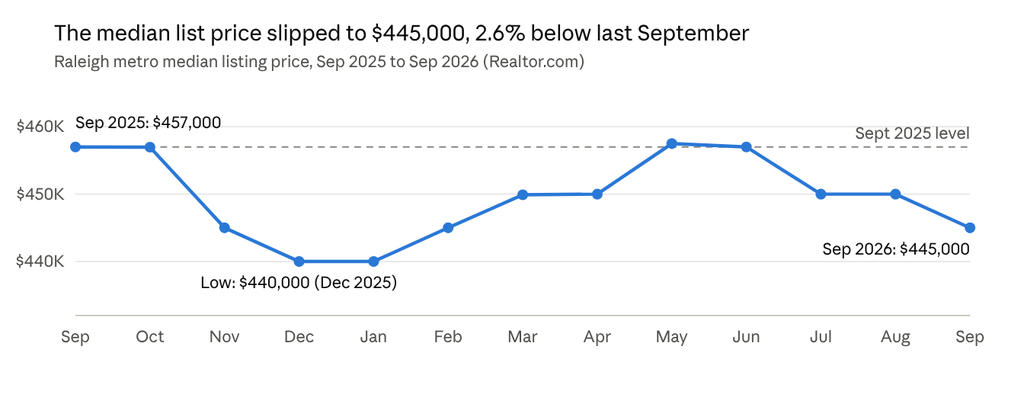
Asking prices have eased too, with the median list price 2.6% below last September.
How the Year Has Unfolded
The softening has been gradual, not sudden. Early in the year the market was still ahead of 2025, with a February median of $459,000 (up 1.9%). By May it had slipped to $447,122 (down 0.6%), the first half of the year averaged $435,844 (down 1.0%), and the three months to September came in at $414,802 (down 4.6%). In other words, the year-over-year gap went from under 1% in late spring to about 4.6% by early fall, while months of supply climbed from 2.6 in February to 4.1 in September.
Mortgage Rates: The Change Buyers Feel Most
The biggest shift versus last year is not price. It is financing. The average 30-year fixed rate reached 7.40% in mid-October, up from 6.19% a year ago. It crossed 7% on September 24, the first time since January 2025.
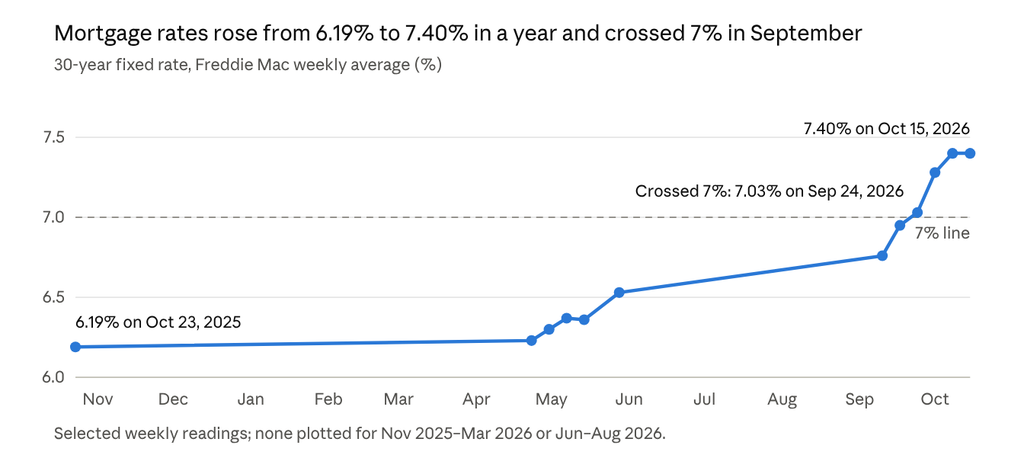
A lower price does not automatically mean a lower payment, and the next section shows why.
What Buyers Tell Me They Worry About
Total Monthly Payment
The question buyers care about most is, “What will I actually pay each month?” The answer has four parts: the mortgage, property taxes, homeowners insurance, and HOA dues where they apply. Here is a typical Raleigh purchase compared with a year ago, assuming 10% down. HOA dues and mortgage insurance are not included.
| Monthly cost | October 2025 | October 2026 | Change |
| Raleigh median sale price (September) | $445,000 | $425,000 | Down $20,000 |
| 30-year fixed rate (Freddie Mac) | 6.19% | 7.40% | Up 1.21 points |
| Principal and interest | about $2,450 | about $2,648 | Up about $198 |
| Property tax (Raleigh city limits) | about $323 | about $322 | About even |
| Homeowners insurance (NC average) | about $201 | about $214 | Up about $13 |
| Estimated total, before HOA and mortgage insurance | about $2,974 | about $3,184 | Up about $210 |
The price is $20,000 lower, yet the monthly cost is about $210 higher. Here is where that comes from:
- Mortgage rate. Rates rose from 6.19% to 7.40%. Every $100,000 borrowed now costs about $692 a month, compared with about $612 a year ago. That is why a $10,000 price cut saves only about $62 a month.
- Property tax. The combined Wake County and Raleigh rate went up about 4%, to 90.91 cents per $100 of value. Because home prices are lower, the yearly bill (about $3,864 on a $425,000 home) stays about the same. Wake County values will be updated in January 2027, so it is worth asking what a home is assessed at today.
- Insurance. North Carolina raised base rates 7.5% in June 2026, the second step of that size in two years. The average premium is about $2,566 a year, or about $214 a month. I always suggest getting a quote before you write an offer.
- HOA dues. Fees usually run $200 to $300 a month, and some homes have none. A $5,000 lower price saves only about $31 a month, so a high HOA fee can erase the savings of a lower price.
Condition and Repair Costs
The second worry is surprise expenses. With my background in finance and home remodeling, I look at both the contract and the condition behind the walls. In a recent negotiation, the home’s condition and the repairs it needed were the center of the conversation. It reminded me why every detail matters, and why my job is to guide the buyer so they can decide without feeling pressured.
It helps to know what the big items cost. A full HVAC replacement typically costs $5,500 to $12,000, and a new roof often costs $5,000 to $15,000. A $5,000 repair credit may cover only part of one major repair, so the inspection results should guide how much you ask for, and local contractor quotes are worth gathering during the due diligence period. (No reliable year-over-year repair cost data was found, so no change is claimed.)
What I Recommend for Buyers
- Start with a pre-approval and set a monthly budget you are comfortable with before you tour. It is the first thing I recommend to every buyer, and with rates above 7%, it matters more than ever.
- Compare several homes in your price range; more inventory makes that possible now. Take your time, and do not feel pressured to rush into the first home you see.
- Ask about negotiation. In the right situation, you can ask for seller credits toward closing costs (2% of a $425,000 home is $8,500) or a repair credit, such as $5,000, when the inspection justifies it. You would not be alone: about two in three Raleigh-area sales this summer included a seller concession. How much is allowed depends on your loan type, so your lender should confirm it, and whether a seller says yes depends on the home, the competition, and how long it has been listed.
What Sellers Are Facing
Matching Expectations to Today’s Market
The hardest part for many sellers is that the market that shaped their expectations has changed. As the September numbers show, homes sold for about 95.6% of their original list price, which means many were reduced along the way.
How I Approach Pricing and Preparation
Every property needs its own strategy, but my process usually looks like this:
- I review comparable sales and the active listings buyers will weigh against yours.
- I make sure the home is well presented, addressing visible condition issues before the first showing.
- I study showing feedback. Few showings or repeated comments tell us whether price or presentation needs attention.
- I adjust when the market tells us to. Depending on the property, that may mean a modest price reduction or an incentive toward closing costs.
I recently helped a seller lower their asking price slightly so the home stayed competitive against other listings. Setting a competitive price from the start is still the best strategy, and it usually beats chasing the market with repeated reductions.
Where Buyers Are Looking: Knightdale, Wendell and Garner
I would not name one area as the favorite without looking at recent inquiries. What I do is compare options against each buyer’s budget, preferred location and needs. Beyond Raleigh itself, many buyers are looking at nearby communities such as Knightdale, Wendell and Garner, where price points and commute trade-offs can differ from central Raleigh. Citywide medians also hide a lot: a condo, a townhome and a single-family home can move at very different speeds, so I price and advise by neighborhood and property type.
Nearby towns tell a different story from the Raleigh average of about $425,000. In Knightdale, Wendell and Zebulon combined, the median held steady at $384,900 even though homes for sale jumped 18.1% to 841 and months of supply rose from 3.6 to 4.2. Homes there sold in about 15 days and received 97.3% of their original list price, up from 96.4%, so values are holding. Garner looks dramatic on paper, with the median down 14.2% from $449,990 to $385,950, but only 74 homes sold, so a handful of sales can swing the number. New listings rose to 137 from 91, homes sold in about 19 days, and available inventory ended slightly lower than last year. Both areas sit about $40,000 below Raleigh’s median, which lowers the monthly principal and interest by roughly $250 at today’s rate with 10% down. Because these are small or combined areas, individual neighborhoods can differ.
What About Luxury Homes?
Higher-priced homes follow their own pattern. In September, 197 Wake County sales were between $1 million and $30 million, totaling $543.1 million, compared with 5,770 sales at $1 million or less. Luxury supply has also been growing: supply for homes at $1 million or more averaged about 3.5 months across Wake, Johnston, Durham and Orange counties this summer. For high-end sellers, pricing to current comparable sales from day one matters more than waiting for a price cut. Current luxury and Triangle listings can be viewed in the active listings section.
What to Expect Next
Seasonally, activity in the Triangle slows through late fall and winter, and buyers often gain leverage. With rates above 7%, I expect payment sensitivity to stay high. If rates ease, buyers waiting on the sidelines could return and tighten competition for well-priced homes. I cannot predict that, so I plan around the numbers in front of us.
Key Takeaways for Buyers and Sellers
- Buyers have more choices and more leverage than a year ago, with inventory up and sellers more flexible.
- Rates, not prices, are driving payments. A home that costs $20,000 less still costs about $210 more per month.
- Look at the full monthly cost. Taxes, insurance and HOA dues can matter as much as the list price.
- Ask for credits. About two in three Raleigh-area sales included a seller concession, so closing-cost and repair credits are worth discussing, guided by the inspection.
- Sellers should price right from the start, using comparable sales, good presentation and showing feedback.
Frequently Asked Questions About Raleigh’s Market
1. Is Raleigh a buyer’s market right now?
It is closer to balanced, with more room for buyers to negotiate than a year ago. Months of supply reached 4.1 in September, but well-priced, well-presented homes still sell. It depends on the neighborhood, price range and property.
2. Are Raleigh home prices dropping?
Median prices are lower than a year ago across several sources, by roughly 2% to 7% depending on the report. The average price was nearly flat in the Doorify data, so individual homes have not all lost that much.
3. Should I wait to sell?
Waiting does not guarantee a better outcome. Pricing against current competition matters more than timing. A free comparative review of your neighborhood is the best way to decide.
Thinking About Buying or Selling in Raleigh?
If you want a plan built around your budget, neighborhood and timeline, I would be glad to help. Let’s have conversation, request a free home valuation, or read more about buying and selling with me. Se habla español.
About the author: Claudia Alzate is a luxury real estate agent with Century 21 Triangle Group who has served buyers, sellers and relocating families across Raleigh and the Triangle for more than 16 years. Her background in finance and home remodeling shapes how she reviews both the numbers in a contract and the condition of a home. She works in English and Spanish. Learn more about Claudia.